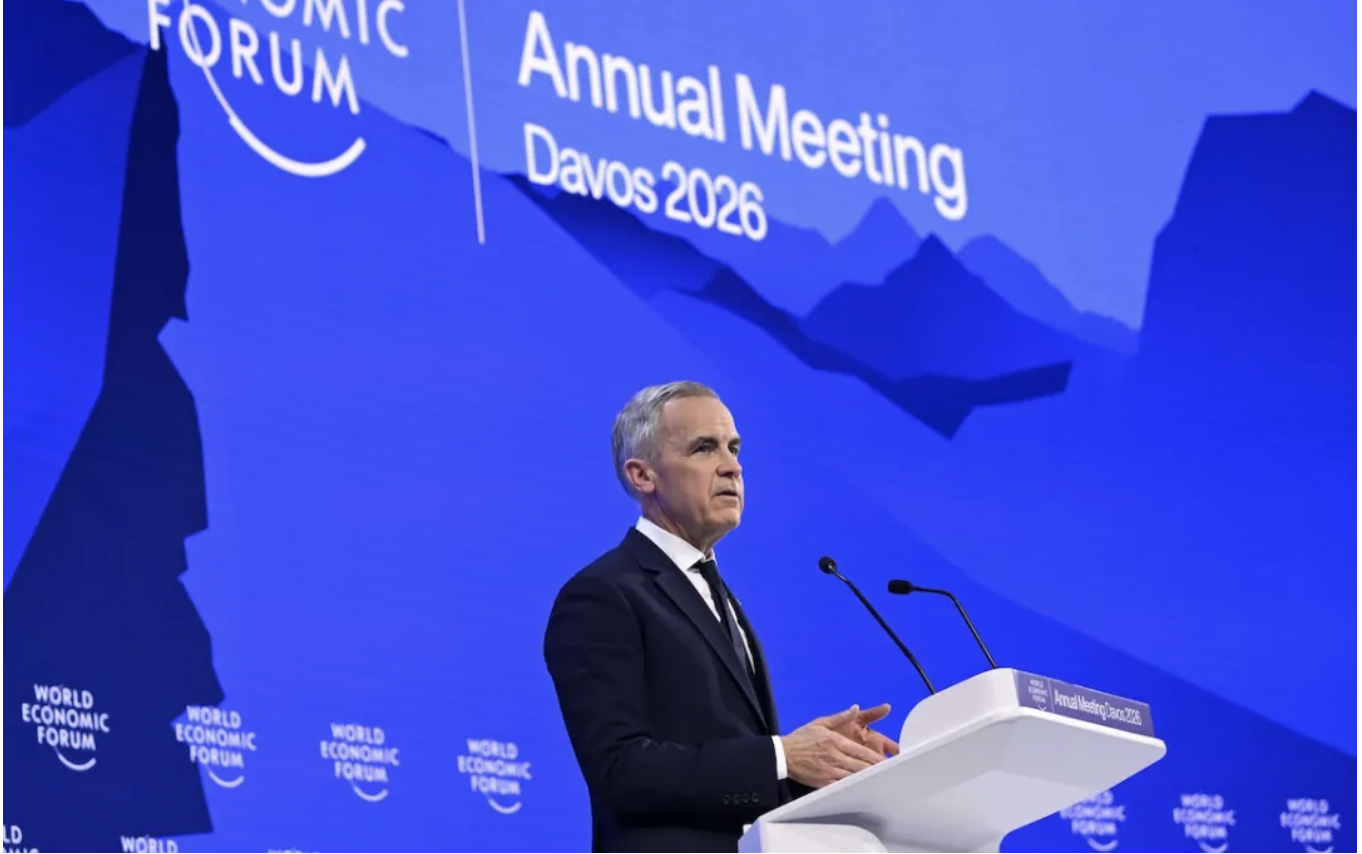
2026 年年初的达沃斯论坛上,加拿大总理马克·卡尼发表了一场被认为“冷静而清醒”的演讲。他谈到全球秩序的裂变、贸易与安全的重组,以及中等强国应如何在价值与现实之间找到新的立足点。
卡尼总理呼吁各国以务实和原则并重的方式重建信任,在不确定的世界中保持清醒与力量,他也提醒各国:在大国博弈中,独行只会被动;唯有协作,才能在规则被重写的时代中,争得发言权。
神通小助手带大家精读其中他谈到有关'A rupture, not a transition'(一次裂变,而非过渡)部分选段👇
让我们开门见山:我们正处在一次裂变之中,而非一次平稳的过渡。
Let me be direct: We are in the midst of a rupture, not a transition.
Let me be direct:直说,不拐弯;政治演讲常见语,强调坦率。
rupture:断裂、撕裂;比喻剧烈的结构性变化。
transition:转变、过渡;对比“rupture”突出了冲击性。
在过去的二十年里,金融、健康、能源和地缘政治领域的一系列危机揭示了极端全球一体化所带来的风险。
Over the past two decades, a series of crises in finance, health, energy and geopolitics have laid bare the risks of extreme global integration.
laid bare:揭露,使暴露。
global integration:全球一体化;20世纪末至今经济全球化的代称。
背景:指2008年金融危机、新冠疫情、能源冲击与地缘冲突。
但更近几年,大国开始把经济一体化当作武器。关税成了筹码,金融体系成了施压工具,供应链成了可被利用的弱点。
But more recently, great powers have begun using economic integration as weapons. Tariffs as leverage. Financial infrastructure as coercion. Supply chains as vulnerabilities to be exploited.
as weapons / as leverage / as coercion:三个省略句并列,增强节奏与警示感。
leverage:施压手段;金融语常用于“资本杠杆”。
vulnerabilities to be exploited:可被利用的脆弱点。
当一体化本身成为从属的来源时,就无法再“在相互受益的谎言中生活”。
You cannot "live within the lie" of mutual benefit through integration when integration becomes the source of your subordination.
live within the lie:出自捷克思想家哈维尔(Václav Havel),意为“在谎言中生活”——即自愿维持虚假的秩序。这个点在卡尼演讲的开头有提到。
mutual benefit:互利共赢。
subordination:从属、受制。
中等强国长期依赖的多边机构——世界贸易组织(WTO)、联合国(UN)以及气候大会(COP)——这些集体解决问题的框架如今都在受到威胁。
The multilateral institutions on which middle powers have relied — the WTO, the UN, the COP — the very architecture of collective problem solving, are under threat.
multilateral institutions:多边机构。
middle powers:中等强国,如加拿大、澳大利亚、韩国。
architecture of collective problem solving:集体应对全球问题的制度框架。
因此,许多国家得出了相同结论:必须在能源、粮食、关键矿产、金融和供应链方面建立更大的战略自主性。
And as a result, many countries are drawing the same conclusions — that they must develop greater strategic autonomy: in energy, food, critical minerals, in finance and supply chains.
strategic autonomy:战略自主性;近年来欧洲常用词,强调摆脱对他国依赖。
critical minerals:关键矿产,如锂、钴、镍,用于新能源与芯片。
这种冲动是可以理解的。一个不能自给自足、无法自卫的国家,选择并不多。当规则不再保护你时,你只能自己保护自己。
And this impulse is understandable. A country that cannot feed itself, fuel itself or defend itself has few options. When the rules no longer protect you, you must protect yourself.
impulse:本能反应、趋势。
feed/fuel/defend itself:三组并列动词,体现国家基本生存要素。
但我们必须清醒地认识到,这样的世界会走向何方:一个堡垒林立的世界,将更贫穷、更脆弱,也更不可持续。
But let's be clear-eyed about where this leads. A world of fortresses will be poorer, more fragile and less sustainable.
clear-eyed:头脑清醒、不抱幻想。
a world of fortresses:堡垒世界,比喻封闭自保的国家体系。
还有一个事实:如果大国连规则和价值的表象都放弃,只追求赤裸的利益与权力,那么交易式外交带来的红利将越来越难复制。霸权国家无法永远靠“关系变现”。
And there's another truth: if great powers abandon even the pretense of rules and values for the unhindered pursuit of their power and interests, the gains from "transactionalism" will become harder to replicate. Hegemons cannot continually monetize their relationships.
pretense of rules and values:哪怕是假装遵守规则和价值。
transactionalism:交易式思维、以交换利益为核心的外交。
monetize relationships:将关系“变现”,这里是讽刺性表达。
盟友们将开始多元化,以对冲不确定性。他们会为主权“买保险”,增加选择,从而重建独立性——一种不再基于规则,而是建立在抵御压力能力之上的主权。
Allies will diversify to hedge against uncertainty. They'll buy insurance, increase options in order to rebuild sovereignty — sovereignty that was once grounded in rules, but will be increasingly anchored in the ability to withstand pressure.
diversify to hedge:多元化以对冲风险,金融术语。
sovereignty … anchored in:主权建立在……之上。
withstand pressure:承受压力、抵抗外部制衡。
在座的各位都明白,这其实就是典型的风险管理——而风险管理是有代价的。但战略自主与主权的代价,也可以通过合作来分担。
This room knows, this is classic risk management — risk management comes at a price. But that cost of strategic autonomy — of sovereignty — can also be shared.
This room knows:对听众(达沃斯商业与政界领袖)的修辞,拉近距离。
comes at a price:是有代价的。
shared:通过合作共担。
共同投资于韧性,比各自筑起高墙要更划算。共享标准能减少割裂,互补关系能实现正和效应。
Collective investments in resilience are cheaper than everyone building their own fortresses. Shared standards reduce fragmentation. Complementarities are positive sum.
resilience:韧性、抗冲击力。
fragmentation:碎片化、分裂。
positive sum:博弈论术语,“正和”,各方都能获益。
对于像加拿大这样的中等强国,问题不在于是否适应新的现实——那是必须的。真正的问题是:我们是只筑更高的墙,还是能做得更有雄心?
And the question for middle powers, like Canada, is not whether to adapt to the new reality — we must. The question is whether we adapt by simply building higher walls or whether we can do something more ambitious.
middle powers:中等强国。
building higher walls:隐喻封闭防御。
more ambitious:更有远见的作为。
加拿大是最早意识到这一警醒的国家之一,这使我们从根本上调整了战略姿态。
Canada was amongst the first to hear the wake-up call, leading us to fundamentally shift our strategic posture.
wake-up call:警钟,比喻必须应对的新现实。
strategic posture:战略姿态。
加拿大人清楚,我们过去那种“地理位置优越、盟友稳固就能自动带来繁荣和安全”的舒适假设,已经不再成立。
Canadians know that our old, comfortable assumptions — that our geography and alliance memberships automatically conferred prosperity and security — that assumption is no longer valid.
comfortable assumptions:自以为稳妥的旧观念。
conferred prosperity and security:带来繁荣与安全。
我们的新方针建立在亚历山大·斯塔布所称的“价值导向现实主义”(values-based realism)之上。换句话说,我们追求的是既有原则又有务实。
And our new approach rests on what Alexander Stubb has termed "values-based realism" — or, to put another way, we aim to be principled and pragmatic.
values-based realism:价值导向的现实主义,芬兰政治学者 Alexander Stubb 的外交理念。
principled and pragmatic:既有原则又务实。
在原则上,我们坚持基本价值:主权与领土完整、除非符合《联合国宪章》,不得使用武力;尊重人权。
Principled in our commitment to fundamental values: sovereignty and territorial integrity, the prohibition of the use of force except when consistent with the UN Charter and respect for human rights.
prohibition of the use of force:禁止使用武力,《联合国宪章》核心原则。
commitment to:致力于。
在务实上,我们承认进步往往是渐进的,利益会分歧,并非所有伙伴都分享我们的价值观。所以我们以开放、战略的姿态积极参与世界,以清醒眼光面对现实,而不是等待理想的世界出现。
And pragmatic in recognizing that progress is often incremental, that interests diverge, that not every partner will share our values. So we're engaging broadly, strategically, with open eyes. We actively take on the world as it is, not wait around for a world we wish to be.
incremental progress:渐进式进步。
engaging broadly:广泛接触。
the world as it is:现实的世界(对照“理想的世界”)。
我们正在调整与各国的关系,使关系的深度能够体现我们的价值观。在世界秩序日益流动的当下,我们优先推动更广泛的合作,以最大化我们的影响力。
We are calibrating our relationships so their depth reflects our values. And we're prioritizing broad engagement to maximize our influence, given the fluidity of the world order, the risks that this poses, and the stakes for what comes next.
calibrating relationships:重新校准关系。
fluidity of the world order:世界秩序的流动性。
stakes for what comes next:未来的利害关系。
我们不再仅仅依靠价值观的力量,而是同时依靠我们自身实力的价值。
And we are no longer relying on just the strength of our values, but also on the value of our strength.
strength of our values / value of our strength:修辞对称,强调“道义与实力并重”。
我们正在国内构建这种力量。
We are building that strength at home.
build … at home:从内部增强实力,呼应演讲主题。
中等强国必须携手共进。
Middle powers must act together.
middle powers:中等强国,如加拿大、澳大利亚、韩国、新加坡等;在大国竞争中既非主导也非被动。
因为如果我们不在餐桌上,我们就会出现在菜单上。
Middle powers must act together because if we're not at the table, we're on the menu.
if we’re not at the table, we’re on the menu:国际关系名言,意为“若不能参与决策,就会被他人决定命运”;语气幽默但意味深长。
但我也要说,大国目前仍能独行其是——它们拥有足够的市场规模、军事能力和话语杠杆,可以制定规则。
But I'd also say that great powers can afford, for now, to go it alone. They have the market size, the military capacity and the leverage to dictate terms.
go it alone:独自行动;在国际政治中意为“单边主义”。
dictate terms:制定条款,主导谈判。
中等强国则不然。当我们只与霸权国家进行双边谈判时,我们是从弱势地位出发的;我们只能接受被给予的条件,并相互竞争,看谁更顺从。
Middle powers do not. But when we only negotiate bilaterally with a hegemon, we negotiate from weakness. We accept what's offered. We compete with each other to be the most accommodating.
bilaterally:双边地。
hegemon:霸权国家。
negotiate from weakness:在弱势中谈判。
be the most accommodating:最迁就、最妥协。
这不是主权,而是“表演”主权——在表面上显得独立,实则接受从属。
This is not sovereignty. It's the performance of sovereignty while accepting subordination.
performance of sovereignty:主权的表演,暗示外表独立但实质依附。
subordination:附属、从属地位。
在大国竞争的世界中,夹在中间的国家面临两种选择:要么相互争宠,要么联手合作,开辟一条真正有影响力的“第三道路”。
In a world of great power rivalry, the countries in between have a choice: compete with each other for favour or to combine to create a third path with impact.
great power rivalry:大国竞争。
countries in between:夹在大国之间的中等国家。
a third path:第三道路,意指独立于大国竞争之外的自主路线。
我们不应让“硬实力”的崛起掩盖一个事实:合法性、诚信与规则的力量依然强大——只要我们愿意共同运用它们。
We shouldn't allow the rise of hard power to blind us to the fact that the power of legitimacy, integrity and rules will remain strong — if we choose to wield them together.
hard power:硬实力,通常指军事、经济等强制性力量。
blind us to:使我们忽视。
legitimacy, integrity and rules:合法性、诚信与规则——软实力的核心。
wield them together:共同运用它们,强调合作的重要性。